 By Dr. Muhammad Junaid Fateh
· Updated · 5 min read
Key takeaways
- There is no fixed best age; a transplant tends to work best once your pattern of hair loss is clearer and more stable.
- Very young men are often advised to wait, because their final pattern is hard to predict and donor hair is limited.
- Medical treatment, and sometimes PRP, is often tried first to slow loss and protect existing hair.
- A good plan allows for future loss, with an age-appropriate hairline and donor hair kept in reserve.
- There is no strict upper age limit; general health and donor supply matter more.
There is no single best age for a hair transplant, but it tends to work best once your pattern of hair loss has become clearer and more predictable, which for many men is from the mid to late twenties onwards. How fast you are losing hair, your family pattern, your donor supply and your willingness to protect the hair you still have matter more than your age alone.
This guide from Dr. Junaid Fateh explains why age matters, why very young men are often advised to wait, and how a good plan allows for the hair loss that may still be to come.
Why age matters at all
Male pattern hair loss is progressive. It usually starts at the temples or crown and can continue for many years. Hair moved from the back and sides of the scalp tends to resist this process, so transplanted hair usually keeps growing. Your other hair on top does not have that protection.
That creates the main risk of operating too early. If a young man has his hairline rebuilt and then keeps losing hair behind it, he can end up with a strip of transplanted hair at the front and a thinning zone behind. Fixing that later needs more grafts, and donor hair is limited. You cannot grow more of it.
Hair loss stages in plain words
Doctors often describe male pattern loss using the Norwood scale. In simple terms:
- Early stage: the temples start to recede and the hairline looks a little higher.
- Middle stage: recession deepens into an M shape, and the crown may start to thin.
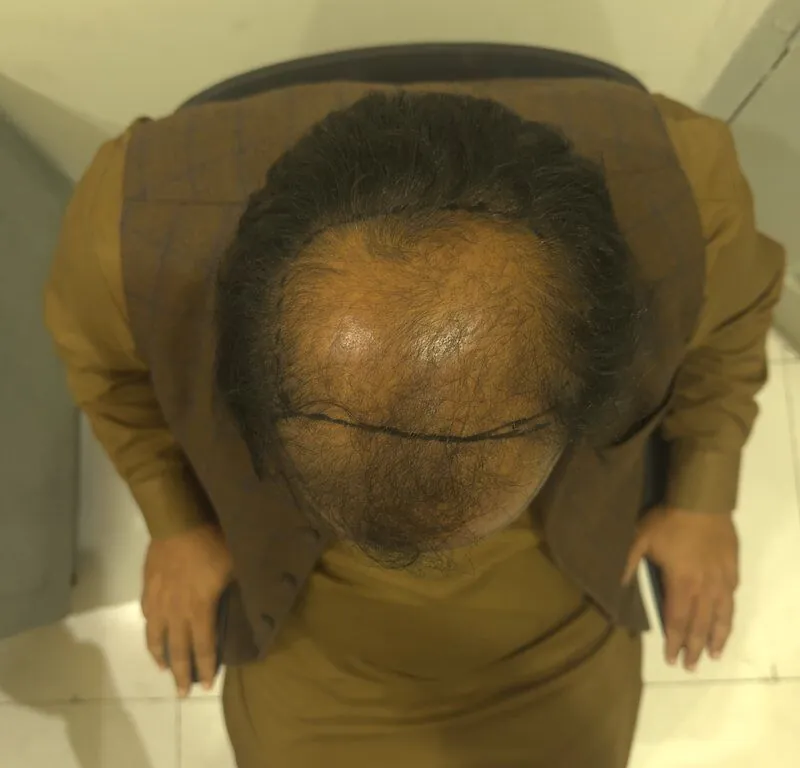
- Advanced stage: the top of the head becomes bald, leaving a horseshoe of hair around the sides and back.
Men who start losing hair early often go on to lose more over time, although this varies. Your father’s, uncles’ and grandfathers’ hair can give a useful clue to where you may be heading.
Why very young men are often advised to wait
Many men first notice hair loss in their late teens or early twenties and want it fixed quickly, sometimes before a wedding. That feeling is understandable, but there are good reasons to slow down:
- Your final pattern is unclear: it is hard to predict how much hair you will eventually lose.
- Hairline expectations: a young man often wants a low, teenage hairline. That uses many grafts and can look out of place as he gets older.
- Donor supply: grafts used now are not available later, when you may need them for the crown or mid-scalp.
- Time to try treatment: medical treatment can slow loss and sometimes thicken existing hair, which may change what you need.
This is not a fixed rule. A younger man with limited, stable loss and a clear family pattern may be suitable. Hair transplants are not usually advised for teenagers, and hair loss at that age should be checked by a doctor. Dr. Junaid assesses every person individually.
Medication first: protecting the hair you have
For many people, the first step is not surgery but protecting existing hair:
- Medical treatment: medicines such as minoxidil, and finasteride for men, are widely used to slow pattern hair loss. They need to be prescribed and monitored by a doctor, can have side effects, and their effect usually fades if you stop. It often takes several months to judge whether they are working.
- PRP hair therapy: PRP uses plasma from your own blood to support thinning hair. The response varies, and it works best in early thinning. The comparison of PRP vs hair transplant explains where each fits.
- Checking other causes: sudden heavy shedding after dengue, typhoid, stress or childbirth is often temporary, while low iron or thyroid problems need treating directly. Dr. Junaid may ask for blood tests before suggesting surgery.
Starting treatment early can give you time and may reduce how much surgery you eventually need.
Planning for future hair loss
If a transplant is right for you, a good plan looks ahead, not just at today:
- An age-appropriate hairline: placed so it will still suit you at forty and fifty, with a soft, natural edge.
- Front first: the hairline frames your face, so it is often the priority when grafts are limited.
- Donor hair in reserve: some grafts are kept back in case you need more work later.
- Ongoing protection: medical treatment to slow loss around the transplanted area.
- Realistic expectations: many people choose a second session years later as their hair changes.
Age at a glance
| Age group | What is usually considered |
|---|---|
| Teens | Medical check for the cause; a transplant is not usually advised |
| Early twenties | Medical treatment first; surgery only in selected cases with a cautious plan |
| Mid twenties to thirties | Often suitable once the pattern is clearer, with a long-term plan |
| Forties and above | Often suitable; general health and donor supply are checked carefully |
These are general patterns, not rules. Your own assessment decides.
Is there an upper age limit?
No strict one. Men in their forties, fifties and beyond can be good candidates, because their hair loss is often more settled and their expectations realistic. Dr. Junaid checks conditions such as diabetes, high blood pressure and heart problems, and asks about blood-thinning medicines, because these can affect safety and healing.
What about women?
Hair loss in women is usually more diffuse, with thinning across the top rather than a receding hairline. The cause is often investigated first, and medical treatment or PRP is usually tried before surgery. A transplant may suit some women with a stable, well-defined area of loss, such as thinning from tight hairstyles or a scar.
What Dr. Junaid looks at
At your consultation, Dr. Junaid considers your age, family history, the pattern and speed of your hair loss, the density of your donor area, your hair character and your general health. He then explains whether surgery makes sense now, later or not at all. For a wider overview, see the hair transplant in Lahore page, and the FUE vs FUT guide if you are comparing methods.
Talk to Dr. Junaid
If you are unsure whether now is the right time, send photos of the front, top, crown and back of your head on WhatsApp and book a consultation in Lahore. A video consultation is available if you live in another city or abroad. Dr. Junaid will give you an honest view of your options, including when waiting is the wiser choice.
This article is general information and not a substitute for a personal medical consultation.
Quick answers
Can I get a hair transplant at 20?
It is possible in selected cases, but many men of this age are advised to wait. Hair loss that starts early is hard to predict, and a transplant done too soon can leave an isolated hairline if the hair behind it keeps thinning. Medical treatment is often tried first.
Am I too old for a hair transplant?
There is no strict upper age limit. Many men in their forties, fifties and beyond are suitable, because their pattern of loss is often more settled. What matters is your general health, any medicines you take and how much donor hair you have.
Do I need to keep taking medicine after a hair transplant?
Transplanted hair does not usually depend on medicine to keep growing, but your own hair around it can continue to thin. If you are still losing hair, Dr. Junaid may suggest continuing medical treatment to protect it.
Will my transplanted hair fall out as I get older?
Hair taken from the stable donor area at the back and sides of the scalp tends to keep growing long term. Like the rest of your hair, it may become a little finer with age. Results vary between people.
About the author
Dr. Muhammad Junaid Fateh
Plastic, Cosmetic & Reconstructive Surgeon (MBBS, FCPS (Plastic Surgery)) seeing patients in Lahore. Read more about Dr. Junaid.